
ECPAT International contributes critical knowledge and evidence to inform advocacy and action against the sexual exploitation of children. Explore our research below.

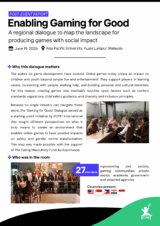
Gaming for Good was a regional dialogue organised to map the landscape for producing games with social impact. The event brought civil society, gaming communities, the private sector, academia, government and attached agencies together to collect different perspectives on what it truly means to create an environment that enables online games to have positive impacts on safety and gender norms transformation.
Available in: English
This data snapshot, produced through a collaboration between ECPAT International and GamerSafer, explores practical, scalable approaches for designing community safety in online gaming environments, with age-specific and gender-informed considerations. It is based on an in-game survey which explored the help-seeking behaviours, community perceptions, and gender expression of 1,991 child and youth players from the Minehut community.
Available in: English
This toolkit brings together practical exercises, creative methodologies, and ethical guidance to support children in exploring their digital experiences, identifying online opportunities and risks, and developing their own ideas for creating safer digital spaces. Although originally developed for participatory research with children on the move in Greece, the toolkit is designed as a flexible resource that can be adapted to different contexts and groups. It is intended for researchers, practitioners, and facilitators seeking to conduct participatory, ethical, trauma-informed, and child-centred engagement on issues related to digital technology, online safety, and child protection.
Available in: English

Children on the move’s digital connectivity needs often conflict with safe navigation. In this context, ECPAT International and ARSIS conducted a research project to explore the perceptions and experiences of children on the move in using technologies, the manifestations of technology-facilitated harms, including sexual exploitation, and how to build safer online environments for children. Participatory sessions were conducted with 32 children on the move (aged 14–17), including 9 girls and 23 boys living in ARSIS accommodation facilities. Through structured and playful activities, children created and narrated fictional digital characters (avatars), allowing them to safely express experiences, perceptions of risk, and ideas about digital safety without requiring personal disclosure. To complement children’s perspectives, the research included interviews with 17 service providers in Greece and 25 global key informants working on digital safety and child protection. Children on the move described technology as central to their daily lives, functioning both as an everyday tool and as a lifeline during their journeys. Digital devices supported communication with family and peers, adaptation to new environments, learning, entertainment and access to information, while also helping children navigate unfamiliar places, overcome language barriers, and stay safe. Children’s digital engagement was shaped by intersectional factors, including gender, background, and mobility conditions.
Available in: English, Greek
These documents capture key lessons generated from the Children Know Better project, exploring how to engage children safely, ethically, and meaningfully in participatory research and advocacy on child sexual exploitation and abuse.
Available in: English
Ces rapports visent à fournir une compréhension contextualisée de l’exploitation sexuelle des garçons au Burkina Faso, en Côte d’Ivoire, en Guinée et au Niger. Ils se concentrent sur les perceptions au sein des communautés locales, les facteurs qui exposent les garçons à des risques accrus et les besoins en matière de prévention, de protection et de services de soutien.
Available in: French